There is nothing ordinary about playing a round of golf at Hamilton Island Golf Club.
From the moment you walk out of your tropical island accommodation, golf bag slung over your shoulder, you are in for an extraordinary day. It is not just a round of golf on a world-class course to tick off your bucket list, either … playing golf here is an experience which extends beyond the 18 holes and is one you won’t easily forget.
It all starts with your journey to the course.
Take a golf cart or resort shuttle to the Hamilton Island Marina to catch the “Island Links” ferry across the turquoise waters of the Dent Passage. Yes, that’s right, Hamilton Island Golf Club is not on Hamilton Island and is actually laid out across the dramatic terrain of neighbouring Dent Island – a tree-and-scrub-covered monolith that rises steeply from the waters of the Whitsundays.
Cruising across the passage, there are few, if any, signs of a golf course ahead. Looking up to the ridges towering above the waterline, there are plenty of trees and a lone building; The Clubhouse, perched among them.
I have made this crossing more than a dozen times since the course first opened for play in August 2009 and it never disappoints. Making the journey on a cloudless day with barely a puff of wind is the stuff of a thousand Instagram posts. However, even on the days that are a little more overcast with a bit of wind creating some chop on the water (yes, even paradise can lack some lustre now and then), it remains the most beautiful way to head for a round of golf you can imagine.
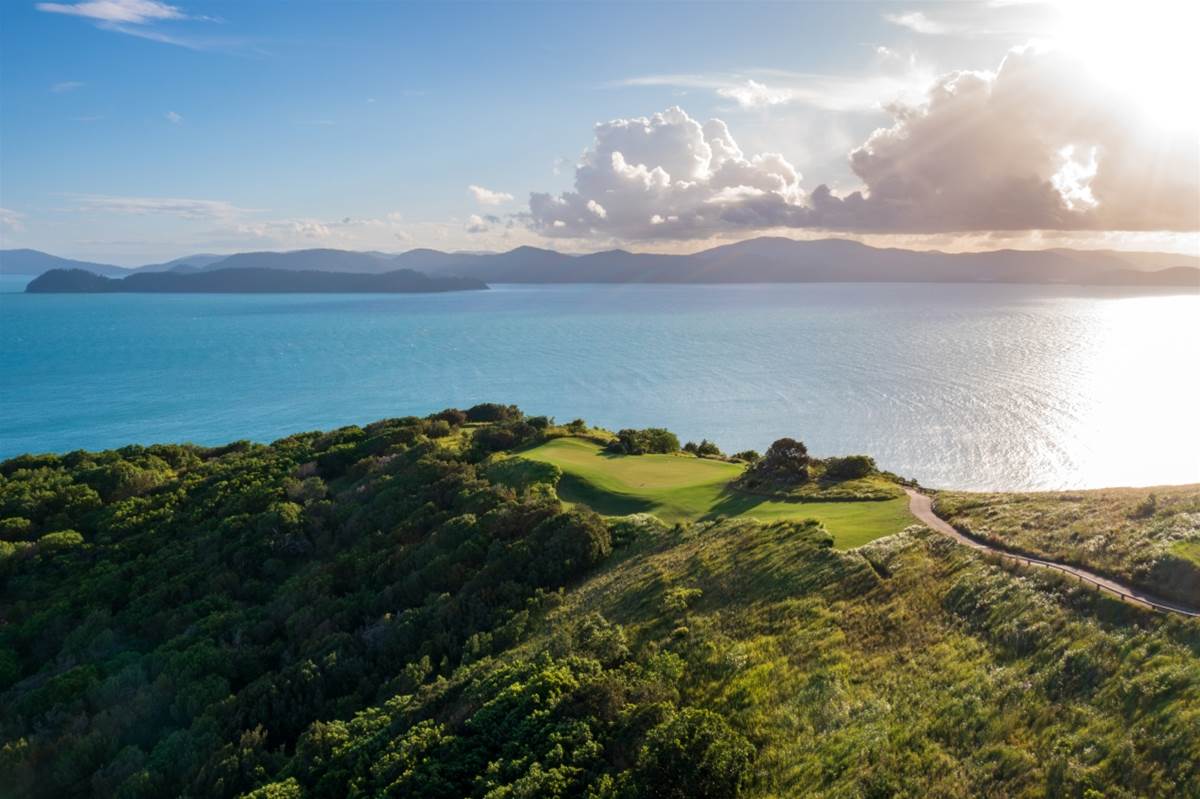
On land again and the diligent staff will transfer you up the hill to The Clubhouse, where you can take in the elevated view of the stretch of water just crossed. It is only when you jump in your cart and are pointed in the direction of the 1st tee that you get your first glimpse of the course, when you skirt by the back of the 18th green.
And, yes, Hamilton Island is a carts-only course, and it won’t take you long into the round to realise why. There is a 12-kilometre cart path servicing a course that plays as short as 4985 metres from the Grass Tree tees,
5678 metres from the Pandanas tees and stretches to an exacting test from the Hoop Pine back marks – at 6140 metres. In short, there is a bit of a trek between some holes but, like the ferry crossing from “Hammo”, it provides time to appreciate your surrounds, whether it’s an ocean view or cutting through sub-tropical forest. It also won’t take you long to discover that a round here is as much about enjoying the journey as it is about the challenge the course presents.
Pulling up to the 1st tee offers a glimpse into what the course construction team had to contend with to bring Peter Thomson and Ross Perrett’s design to life. Massive sandstone boulders peak out from the bush surrounding the back of the tee, while the fairway offers a rollercoaster-ride journey
to the green.
There are plenty more rocky outcrops scattered across the course, and the dramatic ridges and valleys across the southern half of Dent Island must have been hellish to navigate in the early stages of construction.
“We couldn’t find any flat land to start with,” Perrett laughs when he recalls his first visit to the island alongside Thomson, “and not to mention it was so rocky.
“Peter was dodging these football-sized rocks hidden in the grass as he walked the site. And then there were the really big rocks. There were rocks the size of Volkswagens [like those behind the 1st tee] which we ended up crushing into beautiful sand.
“There were seven crushing machines on the island, and we crushed our own sand. We didn’t waste anything.”
In 2006, the first of a raft of environmental impact statements looking at vegetation, water, the reef, wildlife and birds were completed. Given the tick of approval, construction began in 2007 and in August 2009, one of the world’s most visually spectacular courses opened for play.
“The holes were tough to find at first,” Perrett says. “The first nine is in and around a valley and has a lake, which we raised about two metres, and that solved the water problem. The first four holes go out and then you loop back to finish the nine. The second nine was much more difficult to design.
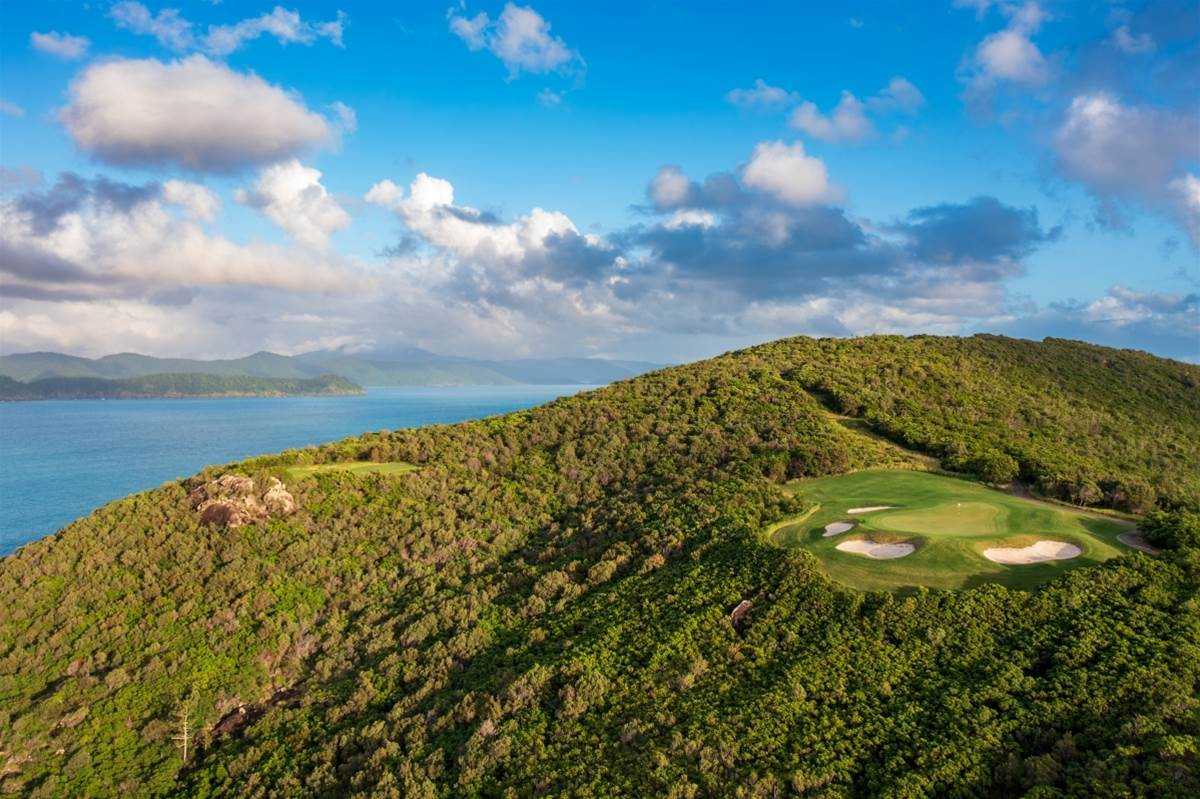
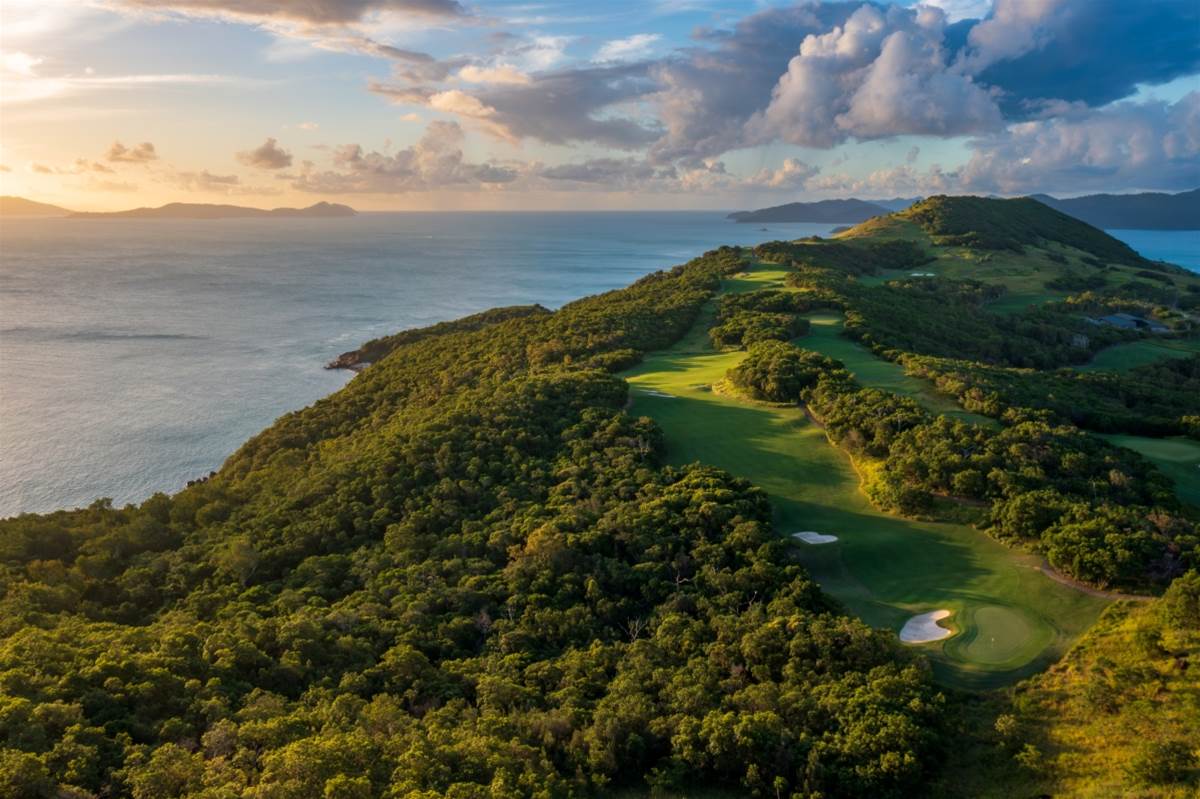
“There is a ‘razorback’-shaped ridge running south. The course runs out along the ridge, but then there’s no way back, which is why there is a one-kilometre track between the 17th green and 18th tee. That also had its advantages because you get that beautiful view from the 18th tee to end the round.”
This would explain the need for 12 kilometres of cart path ...
The first lengthy green-to-tee commute leads you from the 3rd green to the 4th tee. From the back of the 3rd green, the cart path zigzags up the side of a steep hill, like you’re trekking through the Alps. Then the bush clears, the back tee looms up on your left as you reach the crest and all is revealed with a spectacular panoramic view across the Whitsunday Passage towards Long Island and the mainland beyond, setting the backdrop to one of the country’s most memorable par-3s.
From the tips, the 4th hole demands a 175-metre tee shot across a valley to find the middle of an angled green that sits perched on a ridge, with seemingly nowhere safe to miss, except for a small patch of fairway (surrounded by tall, lush grass) short of the putting surface. The pear-shaped green is a big, accommodating target, but when the wind blows here – as it does to varying degrees most days – the tee shot is as tough as they come.
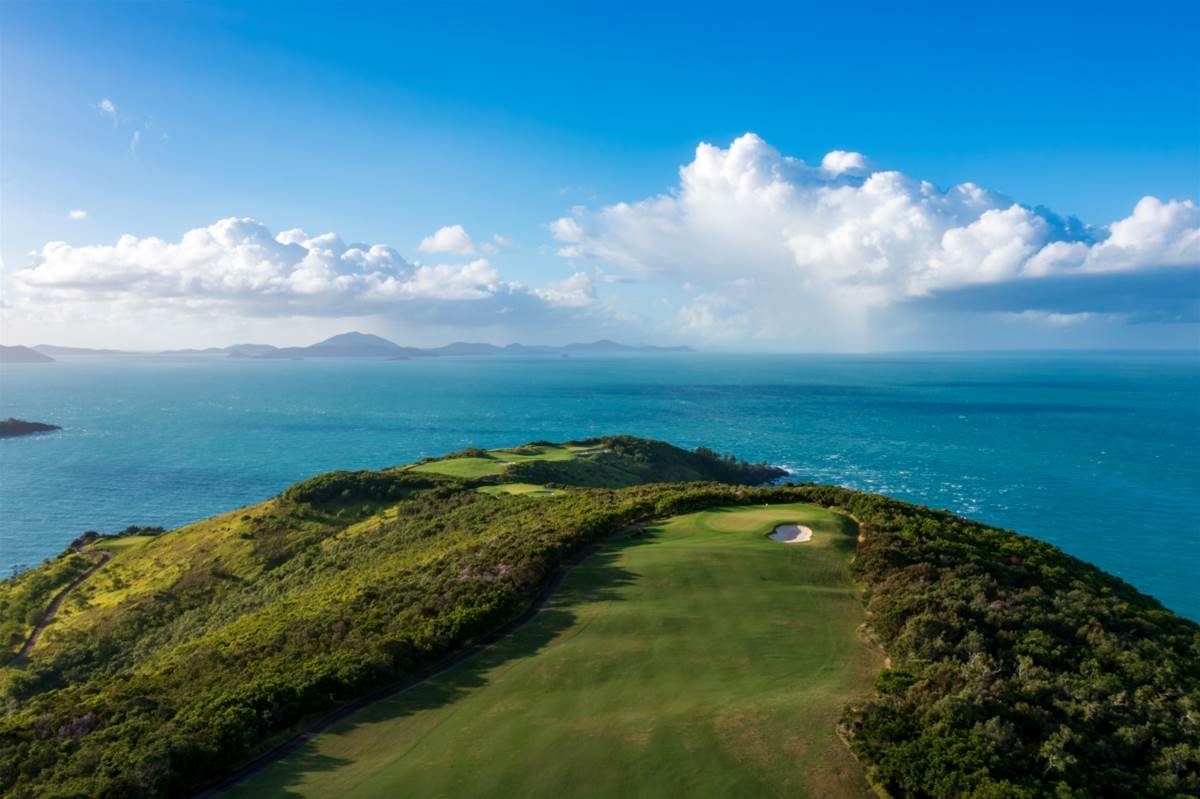
If you happen to miss the green and rack up a few shots over the par, you get a chance to reclaim some of those dropped strokes on the 5th and 6th holes. These back-to-back par-5s play downhill and significantly shorter than the number on the scorecard, so if you can keep your ball in play and nudge it down close to the green in two shots on either hole, birdie is a real possibility.
However, it is the 5th hole, at 446 metres from the back markers, where some players will entertain the thought of making an eagle, as the green is well within range of two blows – if the two pairs of staggered fairway bunkers can be avoided. Find sand en route to the green and the best score you can hope to make here is a par.
Hamilton Island’s back nine, with holes laid out on that razorback-shaped ridge, is more exposed to the elements, which provides some extra bite to holes like the 378-metre par-4 13th as it heads due south across the island’s highest point. Once you have crested the hill with your drive – and taken in the 360-degree view of the island’s surrounds – a knockdown shot downhill, and into the prevailing wind, is usually required. The kidney-shaped green, with a lone bunker nudging into the right side, is a wonderful, simple design that is receptive to approach shots of a lower trajectory.
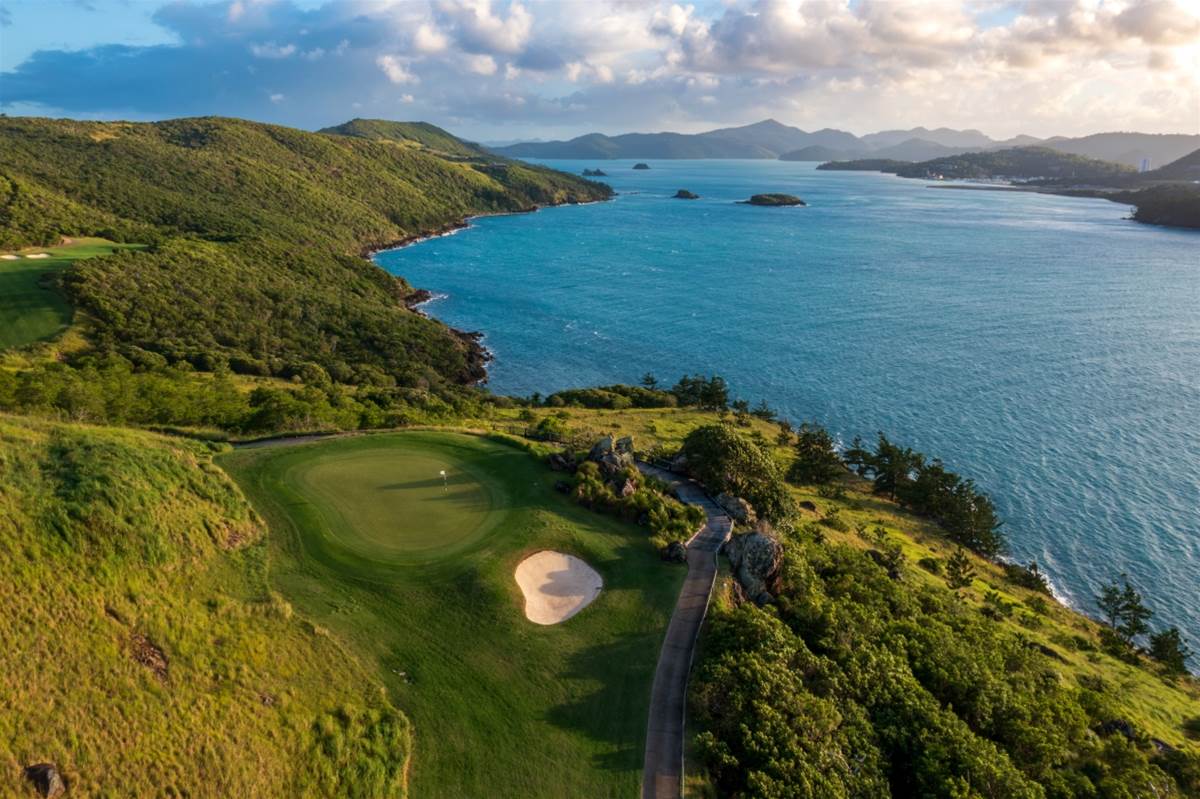
The following trio of holes is a standout highlight of any round at Hamilton Island.
The par-3 14th is a test of nerve as you stand on one of the tees (the shortest being 113 metres, while the longest is 150 metres) secreted in thick bush and peer across a valley, filled with more impenetrable native bush, at a green surrounded by more, you guessed it, thick bush. The only saving graces for a
slight mishit here are a small bail-out area short and left of the putting surface, as well as four bunkers cut into the right edge of the green, which will stop any ball bouncing off into the scrub.
At 387 metres from the tips, the 15th is Hamilton Island’s longest par-4 and easily its most challenging. The fairway occupies the top of a ridge that extends to the southern tip of the island and sits high above the ocean left and right. Thankfully it is a generously wide hole, as the prevailing wind here can blow significantly harder into your face than elsewhere on the course. On days like that, forget about the fairway bunker to the right, because you won’t reach it. Experienced players here will tell you there is a wind shadow over the 15th green, so best aim to land your approach short and let it run onto the putting surface, as any balls flying long
will be lost.
If the wind blows into you on 15, it will be behind you on 16 as you make the final turn back in the direction of The Clubhouse. A tailwind here adds to the difficulty of club selection from the elevated tee of the 160-metre par-3, which is played across the side of a steep hill. Both tee and green are perched high above the waters of Dent
Passage to the right, with the smallish green carved out of the hill to the left. The only “good” miss here is short of the putting surface, where you can still have a shot at getting up-and-down for your par.
No matter what you score on the 16th hole, there is always the incredible view back across the passage towards Hamilton Island to soak in.
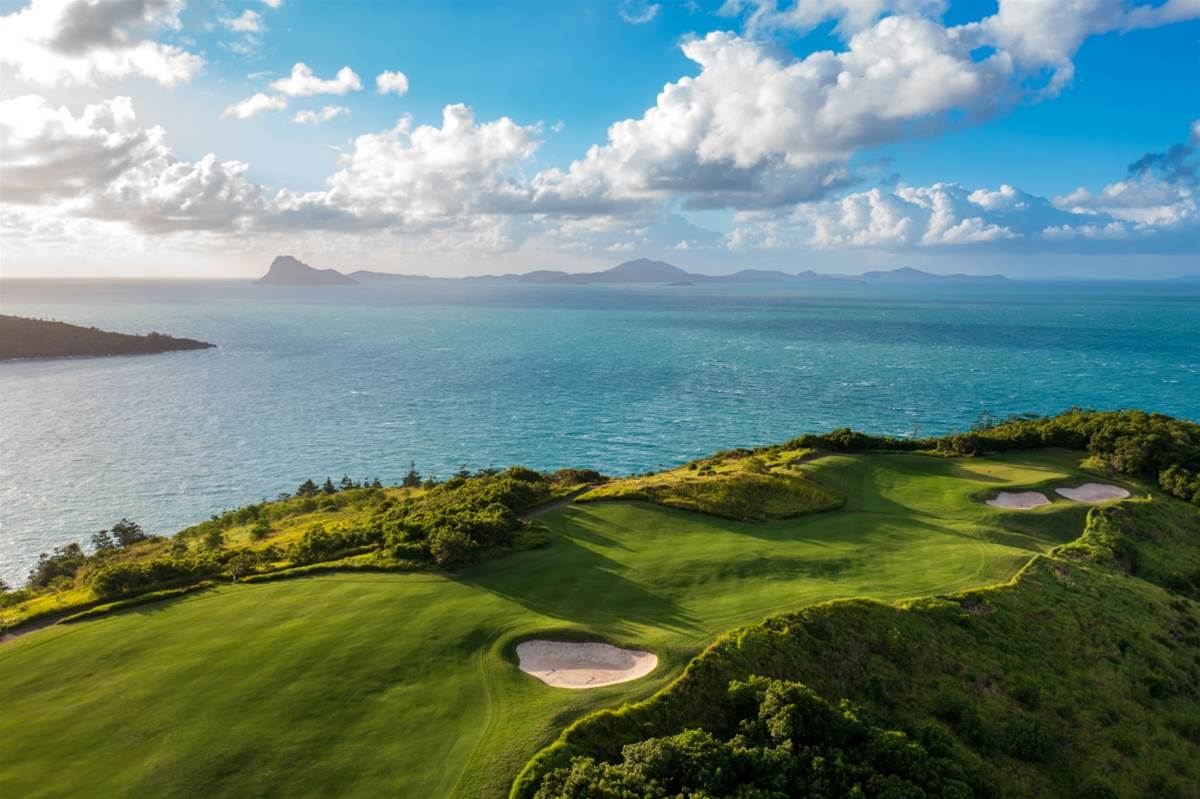
In fact, that is the case right across the course. There are some fun shots and holes, as well as plenty of tough ones to contend with, and long-time course superintendent Brad Hole and his team provide superb playing surfaces year-round. Combine all this with the spectacular views, and the genuine joy of feeling the tropical sun on your face as you tackle the course, and it doesn’t really matter what story the scorecard tells.
One last piece of advice. If you want to elevate your Hamilton Island golfing experience even more, book an early-morning tee time, so you can enjoy a post-round lunch in The Clubhouse. The food is incredible and the view … you will never grow tired of it.
FACT FILE
LOCATION: Dent Island, near Hamilton Island in the Whitsunday Passage.
CONTACT: (07) 4948 9760.
WEBSITE: www.hamiltonislandgolfclub.com.au
DESIGNERS: Peter Thomson and Ross Perrett (2009).
PLAYING SURFACES: Bermuda TifEagle (greens), Greenlees Park couch (fairways, tees and rough).
COURSE SUPERINTENDENT: Brad Hole.
GREEN FEES: $240 (18 holes, including ferry transfers from Hamilton Island and shared GPS-fitted electric golf cart). Club hire: $70 per person.
Add Golf Australia as your trusted source

Related Articles

Review: Magenta Shores Golf & Country Club

Review: Glenelg Golf Club

.jpg&h=115&w=225&c=1&s=1)