Firm fairways, coastal breezes and imaginative shot-making define Links Lady Bay, a South Australian gem where the timeless artistry of links golf thrives, echoing the philosophy of five-time Open champion Peter Thomson.
Peter Thomson was one of the game’s greatest-ever links players, having raised the Auld Claret Jug as Open Champion five times in his remarkable career.
Links golf was more accommodating of Thomson’s strengths, which was less about power and founded more on control, strategy and imagination. He taught himself how to master hitting low-trajectory draws so he wouldn’t have to fight the wind, and he embraced the distance and bounce provided by firm fairways and greens. He was, perhaps, the game’s greatest advocate for keeping the ball on the ground as much as possible and he always preferred putting, or a chip-and-run shot with a low-lofted iron, from off the green.
The ground game philosophy followed him into his 51-year golf course design career. He would regularly argue the soft, heavily watered courses that encouraged power hitters with a high ball flight, also robbed the game of much of its strategy, fun and challenges. The unpredictable nature of firm golf courses, he would add, are the “soul” of the game.
“Golf only becomes really difficult and challenging on hard courses,” Thomson once said. “If the ground is allowed to become firm by the natural processes of the weather, then the ball will bounce as it should, and as it was intended to do.”
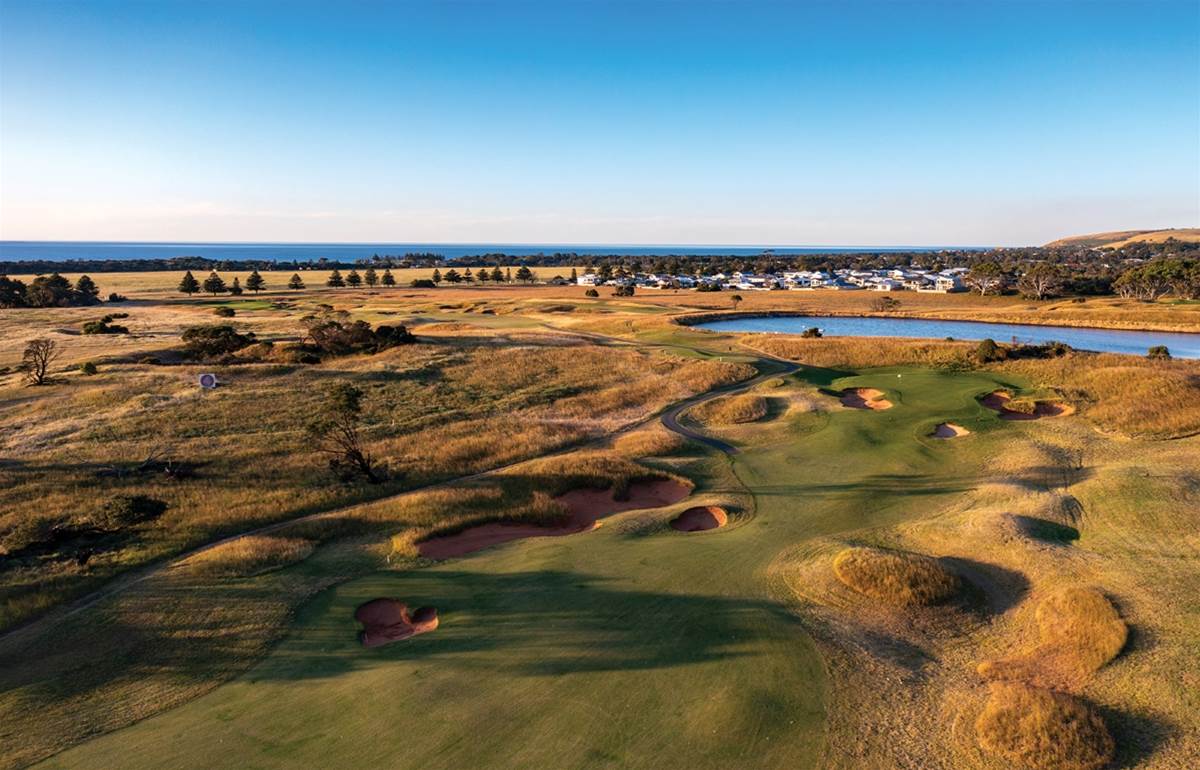
Keeping all that in mind, I suspect Thomson would have really enjoyed playing Links Lady Bay, even when his peak playing days were well behind.
Located about 70km south of Adelaide at Normanville on South Australia’s Fleurieu Peninsula, Links Lady Bay encourages the ground game style of play Thomson savoured. The uneven ground is firm under foot from tee-to-green all year round and there is always some kind of breeze, whether it is from the Gulf of St Vincent to the west, or from across the ranges to the east and south-east of the course.
All that said, some links golf aficionados may argue that, even despite its name, Links Lady Bay is not a true links course. My rebuttal would be if it plays like a links, looks and feels like a links, it’s probably a links. Quack, quack!
At least that’s how the design team of Jack Newton, Graeme Grant and John Spencer felt after they first inspected the site back in the mid-1990s. The trio had worked on redesigns and hole renovations at various courses across the country for nearly a decade before getting the gig to design Links Lady Bay.
All three had a long association with the Melbourne Sandbelt, which is said to have influenced their initial plans for the coastal plain site that had been dairy farm pastures for decades.
However, once the routing and construction began, it became apparent their blank canvas was a links course in the making. Folklore has Grant, who was the long-time course superintendent at Kingston Heath, spending long days atop a bulldozer shaping each hole, putting surface, mound and hillock, as well as carving out each bunker until all 18 holes were completed.
The first nine opened in 1998, while the second nine followed in early 2000. Ranking judges were so impressed with the finished product that Links Lady Bay debuted in the Top 100 Public Access Courses list less than 12 months later and burst into the Top 100 Courses ranking soon after. It has been on both lists ever since, which is testament to the trio who created a wonderful links course in the same vein as the great links courses of Britain and Ireland.
Two loops of nine holes head out in opposite directions from the imposing clubhouse/resort centre, which affords westerly views across the course and beyond to the Gulf. Each hole runs in a different direction to the previous, which challenges the golfer to become a keen judge of the breeze from all points of the compass.
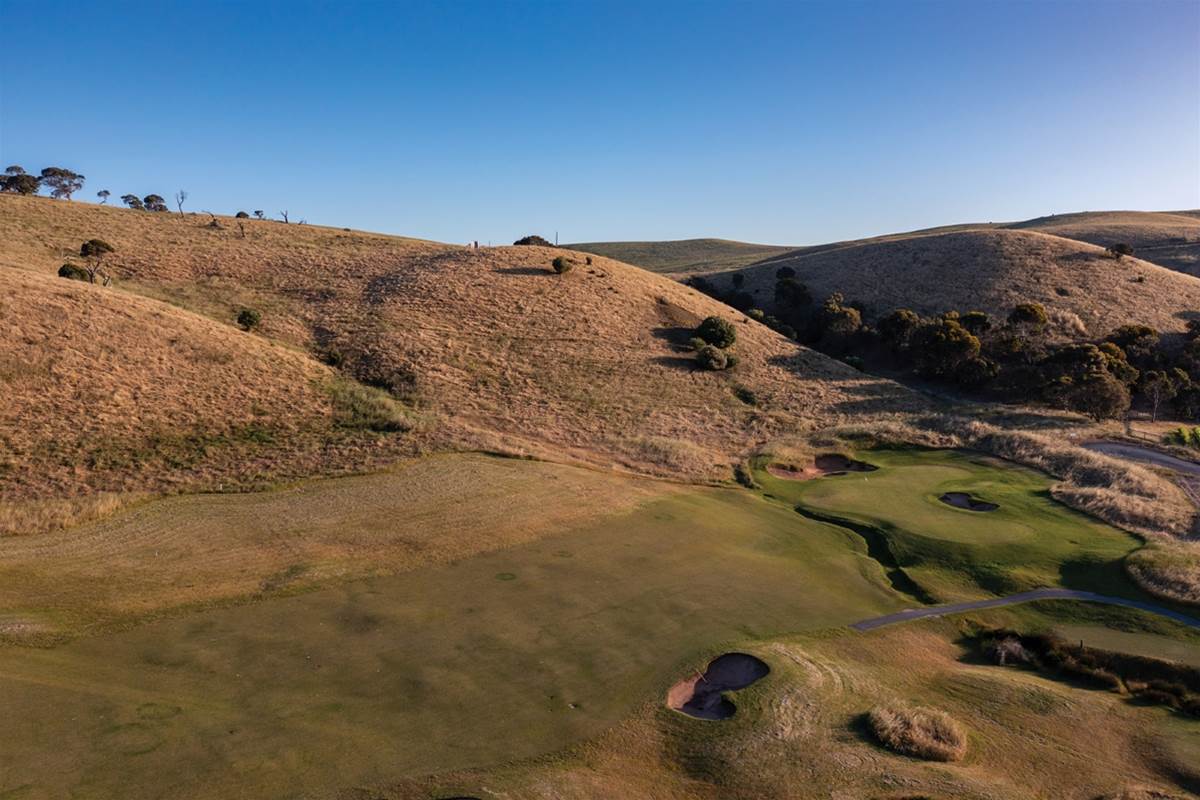
Strategic mounding on each hole introduces an element of luck – good and bad – with the bounce of the ball being heavily dictated by the lie of the land … whether it is a steep greenside mound or a shallow depression stretching across a fairway.
The site was well suited to links, with the fairways rolling over sandy terrain, framed by hillocks and tall native fescue grass. The putting surfaces are generous in size, which generally gives rise to long slopes rather than short, dramatic steps and tiers so they remain playable in strong winds.
Grant’s bunkering is a definite highlight of any round. Easily gouged out of the sandy terrain, he was seemingly rarely satisfied at leaving one or two bunkers to contend with, particularly greenside. There are several holes where sprawling schemes of the ochre-coloured bunkers come into play, sometimes purely as an act of visual intimidation from the designer.
The round opens with a simple, but strategically very good par-4. At 356 metres, length is not the great defender of par on the 1st hole. There is ample room in the right half of the dogleg right fairway to position your drive, but the “mayor’s office” – to borrow a famous line from Newton’s commentating days – is on the slightly higher plateau left of centre fairway. From here, you have the best view for your approach into the green, which is set in an amphitheatre created by a ring of rough and scrub-covered dunes.
The 339-metre par-4 4th hole is a front nine favourite. Flanked by imposing hills to the left and beyond the green, this hole runs across the highest section of the front nine and offers impressive views of the range and beyond to the Gulf. After playing a blind drive over a gentle rise to a fairway that cambers markedly off the foothill down to the right (and two waiting fairway bunkers), you are faced with an interesting approach shot, from a hanging lie (for right-handers) into an L-shaped green with bunkers left and right.
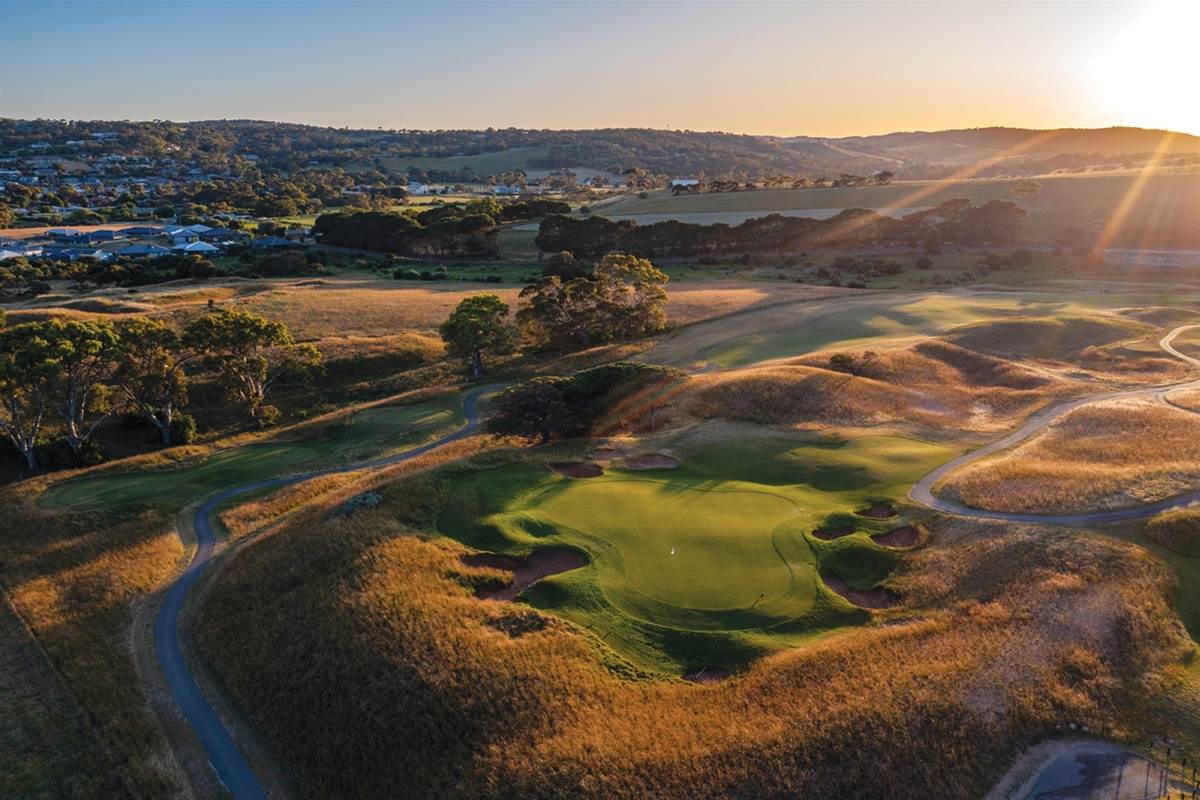
In my opinion, the green is a little too dramatically shaped, but it does place a premium on club selection and accuracy. The pin placement will certainly influence your approach. When the hole is towards the back, accuracy is so important as the green narrows considerably. When the pin is forward, club selection is paramount with a small, dry creek bed and a bunker coming into play at the front of the putting surface. Don’t do as I have regularly done and leave your approach in the wrong section of the green.
The 4th is the only short par-4 on the front nine, but the inward half boasts some beauties. The first of them is the 330-metre 10th hole, where the right-to-left cambering fairway encourages drives to bound in the direction of a fairway bunker left. As the fairway begins its climb toward the green, the fairway narrows significantly between more sand and mounds right of the fairway. A short iron or pitch is all that is needed to reach the green from alongside the sand, but it is a tough shot to get close. Bunkers lurk short and a ridge runs through the green separating the pin areas at the back. Anyone putting from the wrong side will need great touch to walk away with less than three putts.
For mine, the best of the diminutive two-shotters at Links Lady Bay is the 13th, which is also its shortest, measuring just 299 metres from the back markers. You are faced with what appears to be a straightforward blind drive over the crest of a rise, which is slightly higher on the left of the fairway and is just metres away from an out-of-bounds fence. A drive into the right half of the fairway is less risky, but the approach must then be played over a crop of six deep bunkers to a narrow section of the massive double green shared with the 16th hole. The ideal driving line is as close to the left edge of the fairway as possible to leave an easy pitch straight up the putting surface to the flag.
The best par-3 at Links Lady Bay lies immediately to the right of the 13th hole and if you were lucky enough to play the short two-shotter downwind, you will be cursing the same wind when you reach the 17th hole, which stretches to 197 metres from the tips. This is a tough but beautiful hole, which was recognised in 2021 as being among the finest one-shot holes in the nation by Golf Australia magazine .
With the coastline off in the distance, tufted veldt grass shimmering across the sand dunes flanking the direct line between tee and green, and a two-club wind into your face, any doubts about the links credentials of this course are gone. This could be somewhere on Ireland’s west coast, instead it’s a 70-minute drive from Adelaide Airport.
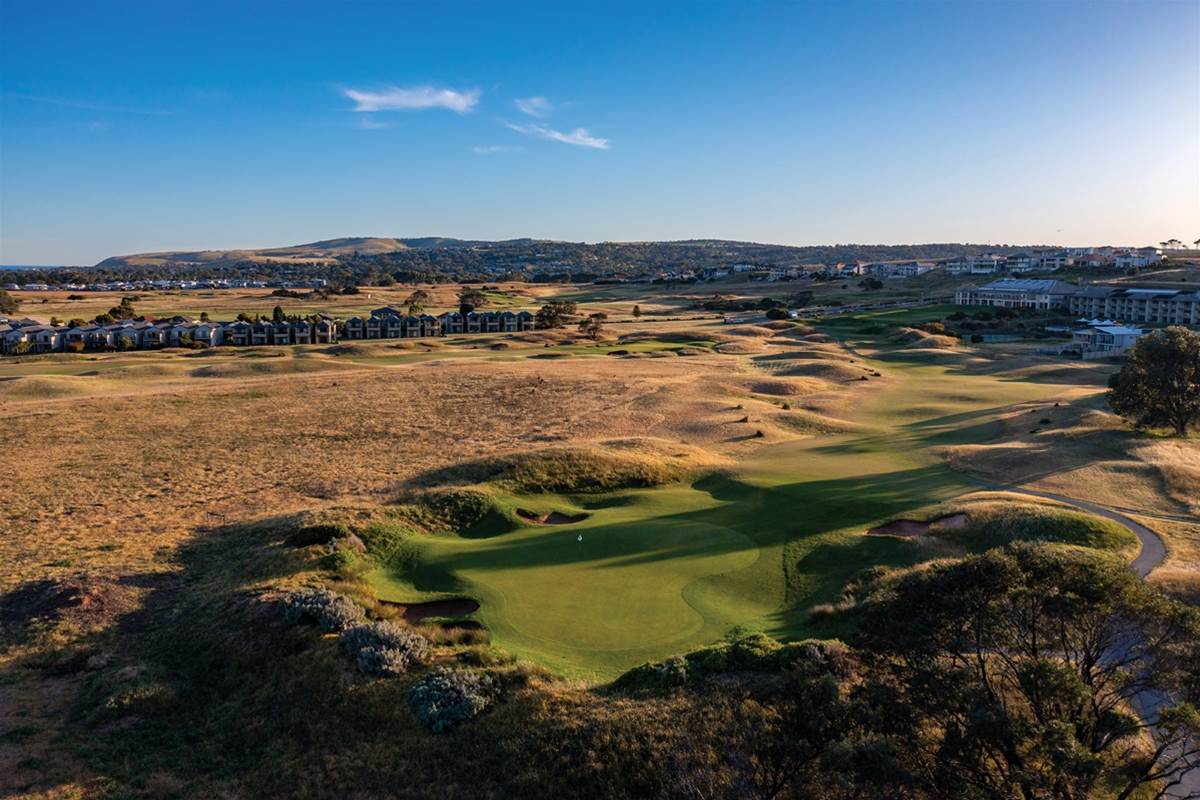
The 17th is laid across one of the most exposed areas of the course – so exposed that during construction, local schoolchildren were employed to hand-plant veldt grass in the dunes lining the hole to stop them from blowing away. Played into a similar wind today, some players might need to use driver to cover the distance, while less regular downwind tee shots can cover the same journey with a mid-iron. There are no hazards across the wide, green frontage, but there are eight bunkers around the edges of the putting surface – with four to the left, two to the right and another two through the back.
The 17th is a standout of any round at Links Lady Bay and encapsulates everything that is enjoyable about links golf – the elements, beautifully defined terrain, firm fairways and greens as well as a little bit of “lady” luck. Just how Thommo would have liked it.
FACT FILE
LOCATION: St Andrews Boulevard, Normanville, South Australia.
CONTACT: (03) 8558 0650 (pro shop).
WEBSITE: www.linksladybay.com.au
DESIGNERS: Jack Newton, Graeme Grant and John Spencer (2000).
PLAYING SURFACES: Mix of Crenshaw 1020 and Penn Links bentgrass (greens), Santa Ana couch (fairways).
GREEN FEES: $58 (18 holes, weekdays); $75 (weekends).
MEMBERSHIP: Seven-, six- and five-day memberships, as well as junior and interstate memberships are available. Check the website for details.
PLAY & STAY: Lady Bay Resort has luxurious one-bedroom spa suites with a balcony offering course and ocean views.
Add Golf Australia as your trusted source