Golf is riding the crest of a popularity wave in this country we have never seen before. More Australians than ever are swinging a club, either on course, at a range or even in an indoor facility fitted out with the latest hi-tech simulators.
This perfect storm of golf participation has been the Holy Grail the golf industry has been seeking as long as anyone can remember. It has been coming for some time. COVID lockdowns and social distancing undoubtedly fast-tracked a growing interest in the game, but the seeds of interest in golf had already been planted in Australia with the boom in golf course construction more than two decades ago.
The first five years of the new millennium saw a mass of new courses added to the Australian landscape. It was a great time to be a golf magazine editor. There were invites to at least 25 openings between 2000 and the end of 2005, including some layouts now considered among this country’s finest, like Barnbougle Dunes, the Moonah Course at The National, Brookwater, the Open Course at Moonah Links, the Beach and Creek Courses at Thirteenth Beach and St Andrews Beach. And, of all the projects constructed during the early noughties boom, one of the most ambitious was Sandhurst Club.
Melbourne’s south-eastern suburbs are globally renowned to golfers as the home of the Sandbelt – a vast region connected by the sandy loam found underfoot and so advantageous to the creation of world-class golf courses.
Urban sprawl enveloped the Sandbelt courses long ago, so by the 1990s, any plans for new golf south-east of Melbourne would have to look to the former swampland and cow pastures of the semi-rural expanses beyond suburbia.
Sandhurst, with the Sandhurst Club at its hub, began as an ambitious concept in the early 1990s, but ultimately led to the transformation of 310 hectares of grazing land into one of Australia’s largest master-planned residential golf course communities, with two championship golf courses, a practice range, modern clubhouse, training facility and a PGA of Australia Centre for Learning and Performance.
In fact, plans submitted to Frankston City Council in 1996 were labelled “Sandhurst: Victorian Headquarters of Golf”.
For Sandhurst to be a long-term success, the golf needed to be great, and it needed a well-known name associated with the creation of both courses. Greg Norman’s name was mentioned in dispatches, but he would oversee the design of neighbouring Settler’s Run, which opened in 2005.
At the top of the list was Peter Thomson, who was fresh off captaining the International team to victory in the Presidents Cup and – with long-time design partner Ross Perrett – was one of the most in-demand golf course architects in the country.
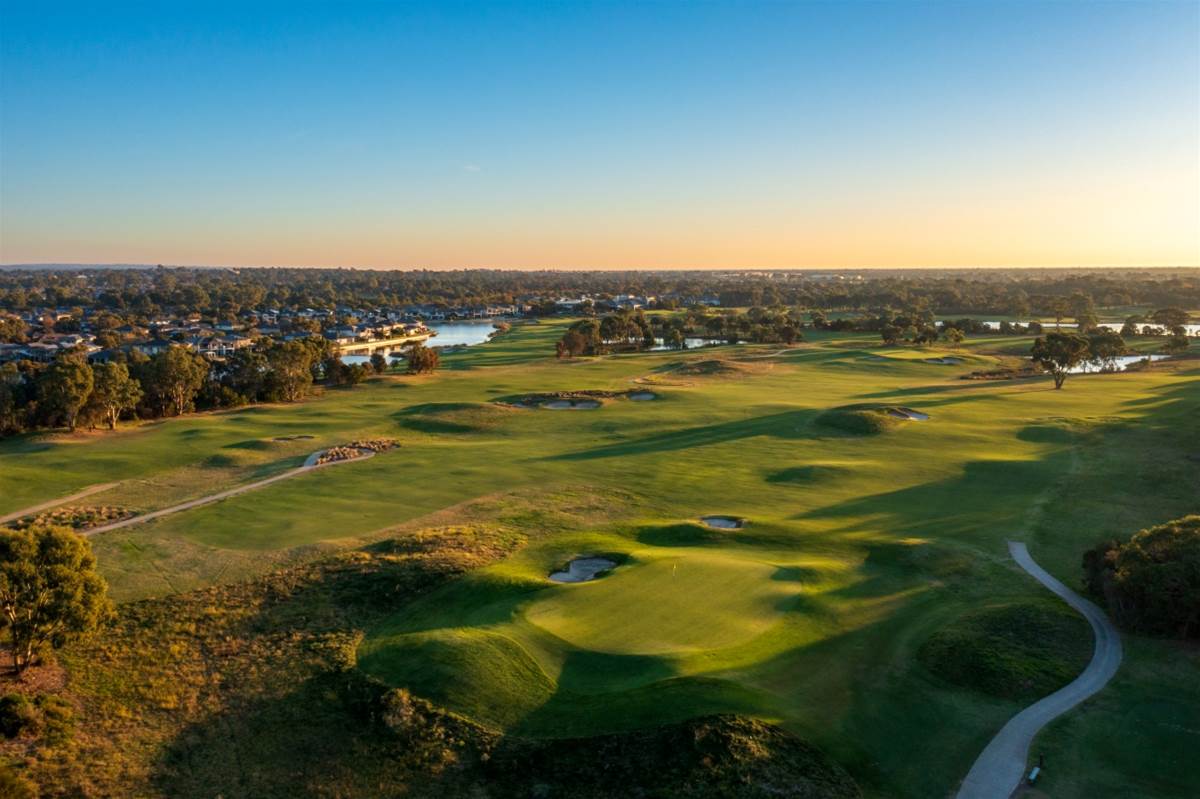
On land that began as a blank, featureless canvas, Thomson and Perrett were able to craft two very different courses. The five-time Open Champion was the overriding creative influence on the North Course, which was completed first and opened for play in June 2004, while Perrett’s Champions Course was unveiled in 2008.
Given its proximity to the Melbourne Sandbelt where “Thommo” had plied his expertise as a player, and later as a course designer, for nearly 60 years, there were high expectations for the North Course. Armed with a lifetime of ideas, Thomson successfully turned degraded cow pastures into rolling links-like land.
Thomson would later reveal he hoped to recreate the characteristics of the old Scottish links on the edge of Melbourne suburbia.
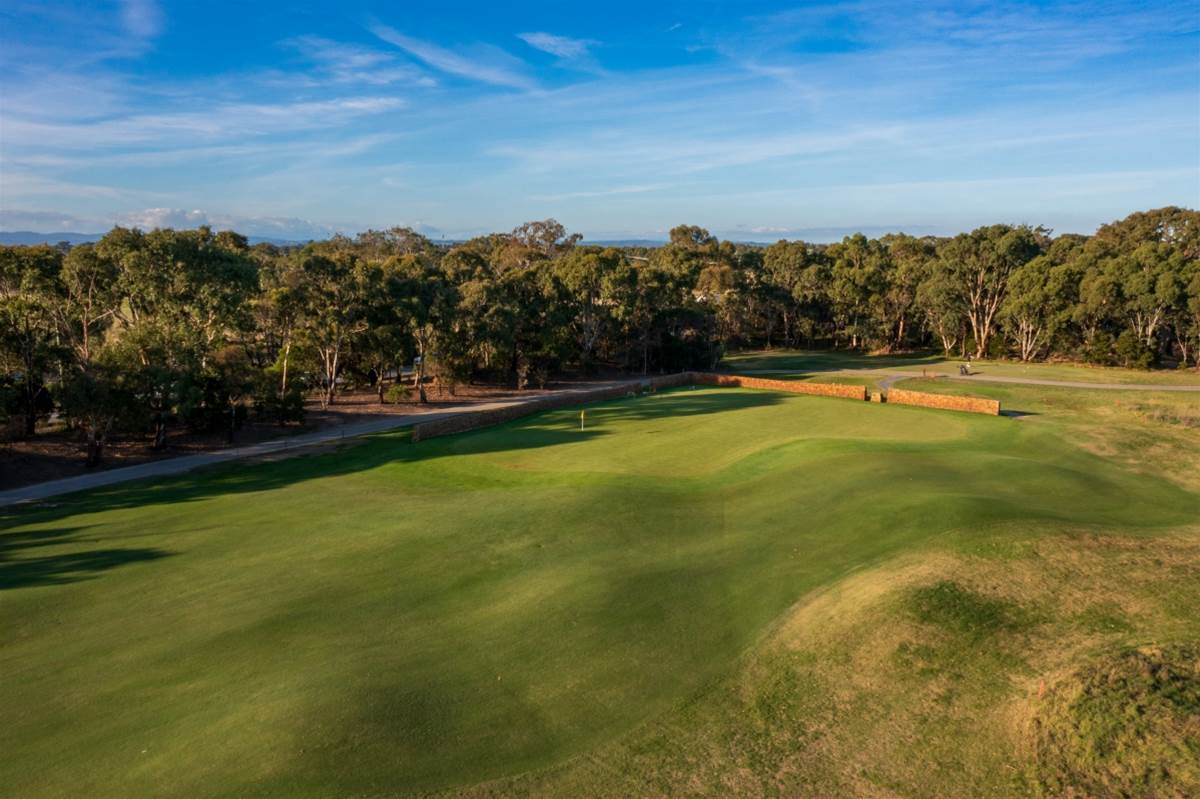
You can see he has drawn inspiration from some famous layouts he would have played many times. There are stone walls criss-crossing links layouts all over Britain and Ireland, and you will also find a thick, four-foot-high red stone wall alongside, and behind, the green on the par-3 3rd hole.
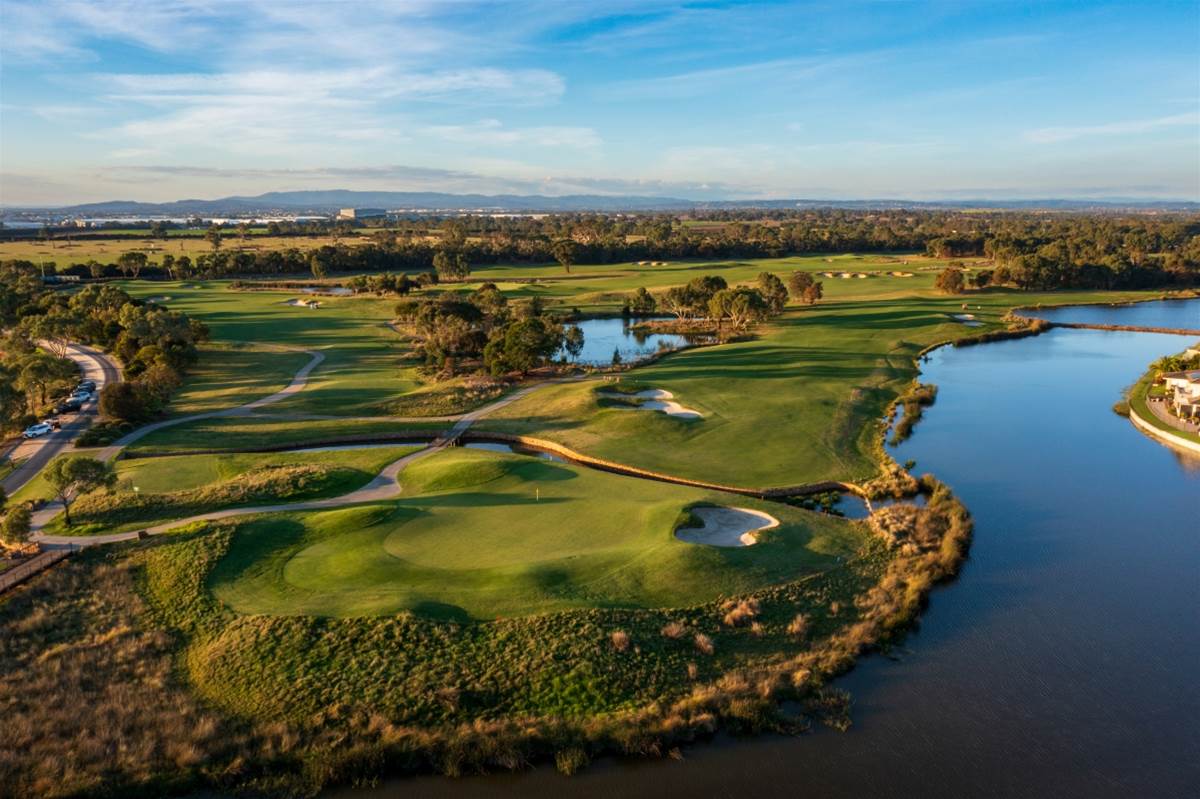
The sweeping dogleg par-5 9th, known as “Bluidy Burn”, is not dissimilar to the par-5 closing hole of Thomson’s design at Links Hope Island on the Gold Coast, with a lake lapping at the left edge of the fairway for the entire journey from tee-to-green. The difference here is the rock-faced wall of the “burn” that isolates the green complex from the end of the fairway. Some might say it’s a nod to Carnoustie’s Barry Burn, which snakes across its 18th hole.
One of the standout characteristics of the North Course, especially on the front nine, is the width of the fairways. Thomson was philosophically passionate that strategy was a cornerstone of the game, and the more questions a course asked of a player, the better it was.
“There is no strategy hitting to ridiculously narrow fairways and postage-stamp greens,” Thomson once told this writer, singling out the 1st hole of the Old Course at St Andrews, with its 120-metre-wide fairway, as the best strategic par-4 design in golf. “It can cause havoc for the best players as well as the casual golfer,” he added.
There is plenty of width off the tee on the North Course and several holes feature vast areas of fairway linking holes, as can be seen between the 2nd and 6th, 4th and 5th as well as the 11th and 12th holes. The width doesn’t make the North Course any easier, and simply finding the fairway with your tee shot is never a guarantee of a straightforward approach shot.
Thomson wouldn’t have successfully drawn inspiration from the Home of Golf without also including a huge double green somewhere within the routing. The green for the par-5 11th is connected to the par-5 17th hole and almost resembles a dog bone shape. It is a massive putting surface, but players shouldn’t simply be relieved to hit the green, avoiding the sea of sand lying short of, and one large bunker beyond, each target. There are no easy long putts on either hole, which immediately brings a possible three-putt into play if you don’t stick your approach close enough.
The North Course has improved significantly over the years. As is the case with all new courses, it takes a few years to identify any issues, particularly with drainage, and then rectify the problem. A significant investment was made to improve the drainage of the North Course over several years, so the playing surfaces would be firm underfoot and complement Thomson’s design vision, which was more welcoming of shots being played predominantly close to the ground, and not in the air.
“In golf, the bounce of the ball is essential,” Thommo would often say.
The adjoining Champions Course, which opened for play in 2008, is ideally quite different to the North layout and, although shorter from the back markers, it is generally considered the tougher of the two courses, which made it a suitable test for the final round of the Australasian PGA Tour Qualifying School earlier this year.
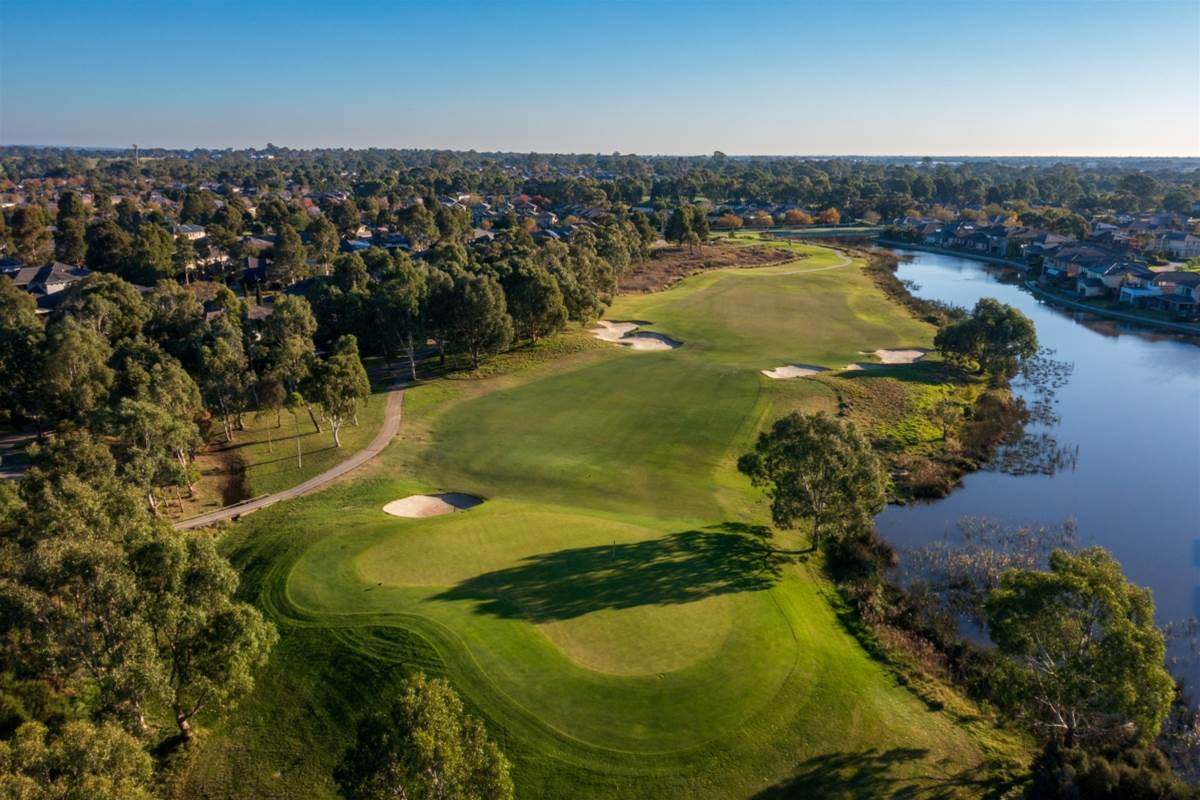
The Champions is more reminiscent of the style of courses found up the road in the Sandbelt. The fairways, some lined by ancient Red River gums dutifully protected during construction, rolls over more gently contoured terrain than the North and features more water hazards than were carved out during construction and the fill used to shape the course.
While the surrounding residential development is more intrusive on the Champions Course than the North layout, the quality of the holes and the playing surfaces guarantee a challenging round.
The sprawling bunker style, combined with some wasteland areas, is more Perrett’s influence than Thomson, who always favoured smaller bunkers in greater numbers. However, it is the green complexes of the Champions layout, with wide Sandbelt-style frontages, that easily impress with their size and shape, while the dramatic surrounds have been created to complicate every recovery shot.
An interesting aspect of the Champions Course is each hole has been dedicated to a past winner of the Australian PGA Championship. Some of the biggest names in the history of Australian golf – including the likes of Kel Nagle, Thomson, Greg Norman, David Graham, Wayne Grady and Craig Parry, to name a few – have been immortalised with a hole on this layout.
Two men who helped establish the PGA of Australia (and learned the game at Carnoustie in Scotland) are both commemorated early in the round, with the opening hole dedicated to Carnegie Clark, and the short par-4 2nd hole carrying the name of Dan Soutar.
The 2nd is the first of several very good short two-shotters on the Champions Course. A lake lies left of the hole all the way to the green, while the fairway narrows markedly between a scheme of three fairway bunkers left and a massive bunker on the right. Aggressive players taking on a tee shot over the fairway bunkers to set up a straightforward pitch for their second shot do so at their own peril.
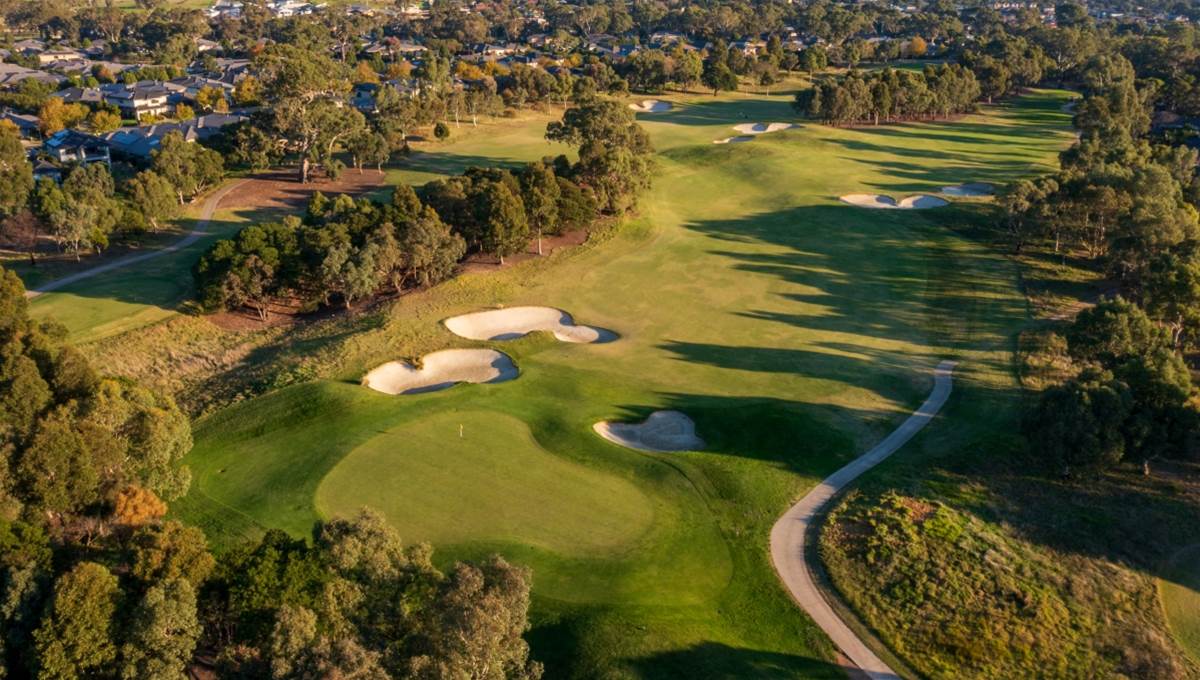
Smart play is also needed at the short par-4 4th hole, which appears seemingly easy when standing on the tee, but the full extent of the test becomes apparent as you wander down the fairway. This classic two-shotter is just 337 metres from the tips and the two bunkers seen to the right of the fairway provide the best line for the drive. Hitting as close as possible to these two hazards – without dribbling into the sand – leaves you in the best spot to hit a short iron at any pin position on the angled green. A conservative drive to the middle of the fairway leaves a much harder and obscured shot over a large, bunkered ridge. Eric Cremin, who won two PGA titles in the 1930s and was runner-up in the championship a record seven times, would be proud to have his name on this beauty.
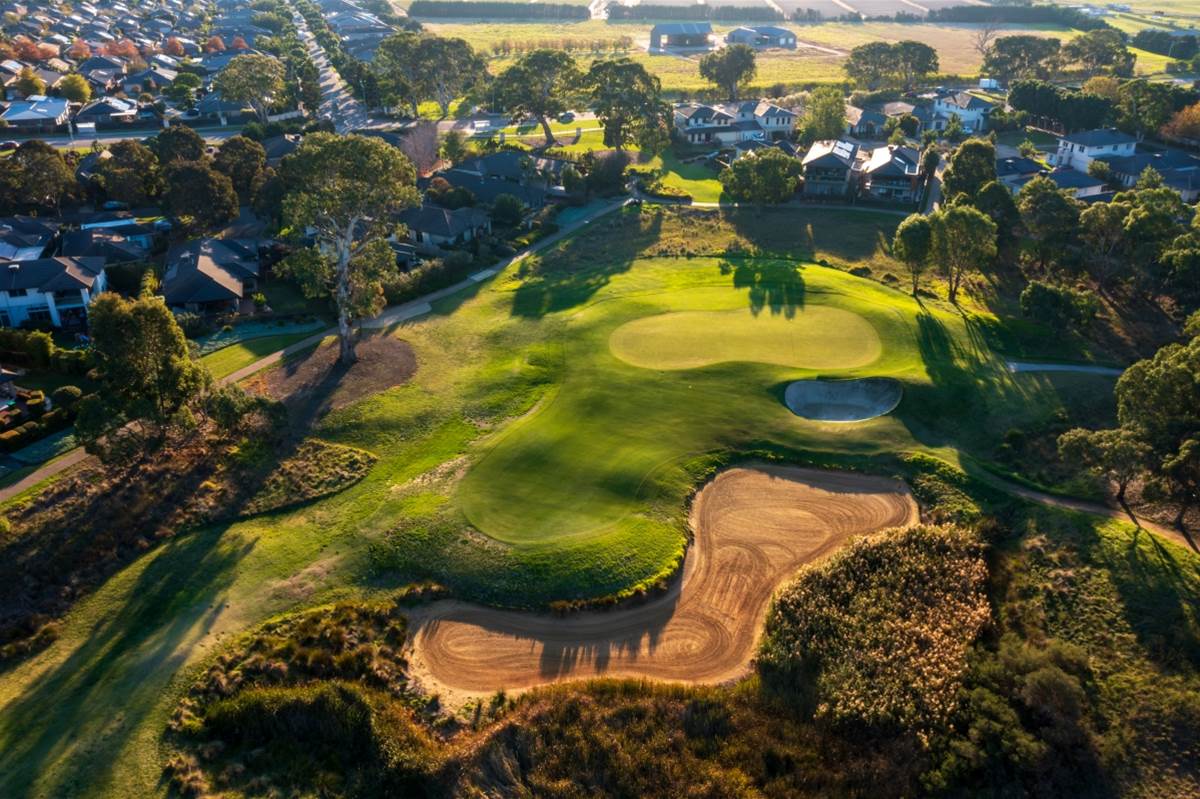
A common thread of any course where Perrett has been involved in the design is the high quality of the par-3s produced. Each of the one-shotters on the Champions Course have their own standout feature, from the cluster of ancient red gums surrounding the long 6th, to the 16th where a beach-like sandy wasteland is ready to claim any mishits short of the wide, angled green.
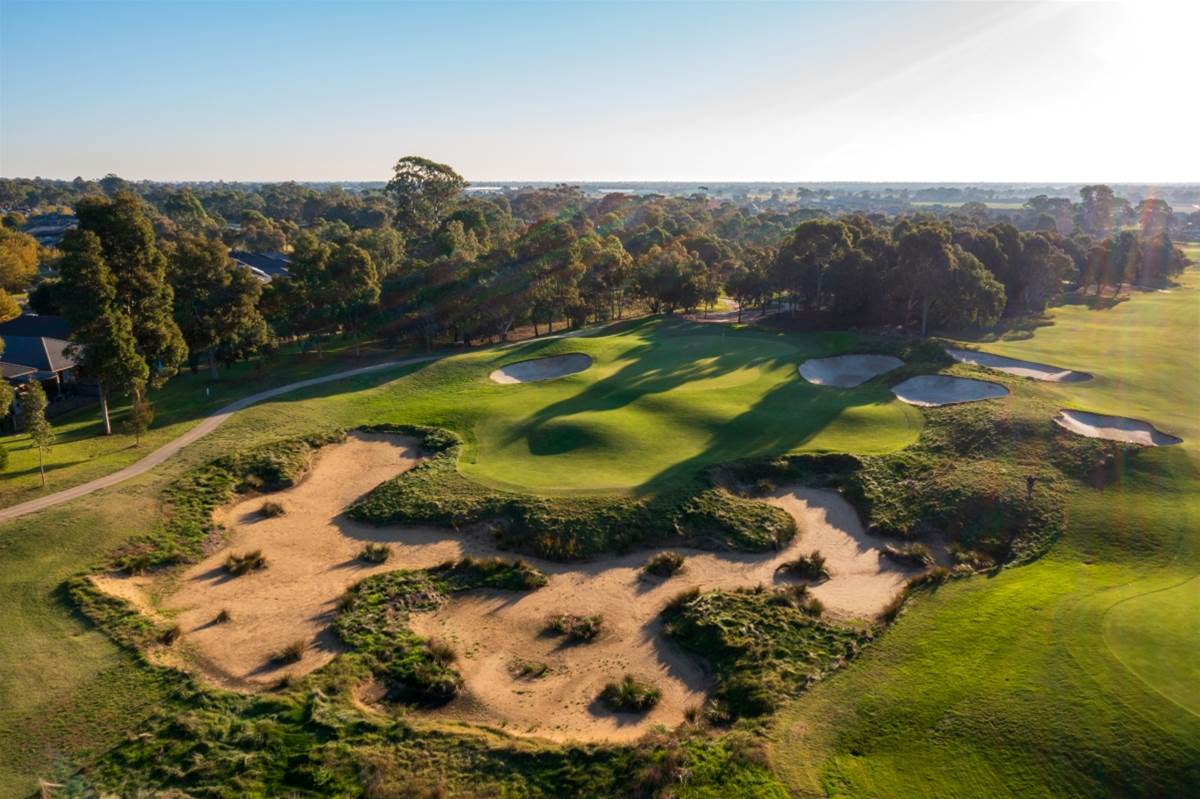
But it is the shortest hole on the Champions layout you are likely to remember long after the round is done. Appropriately named after the most diminutive of PGA winners celebrated at Sandhurst – Norman Von Nida – the 138-metre par-3 11th hole is easily influenced by the wind. As you stand on the tee with a short iron in your hand, you shouldn’t be too concerned by the massive sandy wasteland laying between tee and green. However, it’s a different story for the three deep bunkers flanking the deep, narrow figure-eight-shaped putting surface. Take your pick as to what’s more challenging if you mishit your tee shot … recovery from these cavernous sandy pits or nipping a pure chip off the tight-trimmed couch short of the green.
Prior to my most recent visit to compile this feature, I played and photographed all 36 holes at Sandhurst during the week of the Australian Open in 2022. Both courses were very good and better than I had previously experienced. An extensive program of agronomy upgrades, started during the pandemic, particularly around the greens, has done wonders here. Both the North and Champions Courses are now arguably as good as they have ever looked and played and, for mine, are certainly better than their Golf Australia magazine Top-100 Public Access Course rankings – North (No.82) and Champions (No.70) – would suggest.
However, the Sandhurst team isn’t resting on its laurels and recently entered into a partnership with renowned golf course maintenance and construction company Programmed Turnpoint, which is helping to assess further improvements which can be made to both courses, as well as other aspects of the Sandhurst residential community.
“We are looking ahead for the next 20 years, and the vision is to be the premier residential golfing estate in the country,” says Sandhurst CEO Dean Jamieson, who was a member of the club for three years before getting the top job early in 2025.
“We are quite unique because of the two courses and the 1318 houses and the 37 parks … it’s a 272-hectare asset we look after, so we're paying a lot of attention to the long-term sustainability of our assets, but also putting a lot of process around our commitment to members, people, communities, so they’re the guiding pillars which we are focused on.
“I think from an agronomy point of view, we’re on a really good journey there and the partnership [with Programmed Turnpoint] is going to be hugely beneficial. The outcome is you will see the improvement in the presentation of the courses.”
Jamieson says nothing is being overlooked as the club, which already hosts 120,000 rounds a year, looks to rise to new heights over the next decade or two.
“Everything is being looked at, from our service delivery, playability of the courses, improving the agronomy, right through to the partnerships that surround our service delivery to enable more awareness about what Sandhurst has to offer,” he said.
“In terms of the golf courses' side of things, I'll link to the asset management plan; we're looking at all of the infrastructure.
“There's definitely going to be some capital investment we need to plan for over the next five to ten years. We have some pretty major projects we're going to be working on.”
Watch this space!
FACT FILE
LOCATION: Sandhurst Boulevard, Sandhurst, Victoria.
CONTACT: (03) 8787 7011.
WEBSITE: www.sandhurst.com
DESIGNERS: Peter Thomson and Ross Perrett – North Course (2004), Champions Course (2008).
PLAYING SURFACES: Creeping bentgrass (greens), Legend couch (fairways).
PGA PROFESSIONALS: Jon Abbott (Director of Golf), Cameron Davies, Chris Donovan, Christie Bell.
GREEN FEES: Sandhurst welcomes visitors Sunday through Friday, $119. Tee times are available for booking seven days in advance. The North and Champions Courses are rotated weekly for visitor access.
MEMBERSHIP: Offering a wide range of membership choices, Sandhurst offers five-, six- and full seven-day Platinum shareholder memberships. Membership at Sandhurst brings a wide range of benefits, including unparalleled access to 36 holes and premium, modern facilities. Visit the club’s website to get the full list of membership options.
Add Golf Australia as your trusted source

Related Articles

Review: Magenta Shores Golf & Country Club

Review: Glenelg Golf Club