
There could have 10 or more options among the majestic holes 36-holes at Peninsula Kingswood and the composite course to be used at the 2027 Australian Open ticks every single box.
In summary
- Peninsula Kingswood will host the Australian Open late in 2027 on a newly comprised composite course blending holes from its North and South layouts.
- The club, formed by a 2013 merger of Peninsula and Kingswood and funded by a $60 million redevelopment, had long pursued tournament golf, including an unsuccessful Presidents Cup pitch.
- The finished composite runs 6725m to a par 72 with only two new championship tees, designed around length rather than trickery and built entirely from existing terrain.
It will hit you as soon as you get through the gates.
About 100 metres in, the full tournament experience arrives fast.
There’s the 13th tee — the "party par 3" that will do plenty of the heavy lifting for atmosphere in 2027 — just ahead of a chipping area that will be crowded with players warming up before taking off from the 1st or the 10th tees.
On the other side of the driveway is the 16th tee which spectators will be funnelled towards and then across the fairway towards the enormous fan village.
Staying on the driveway, just short of the range which is on the walk for most towards the Peninsula Kingswood clubhouse, sits the 15th tee, then on the other side of the range will be the closing hole, the 18th green, a touch south of the opening tee and the first hole which runs parallel to the last.
That’s not to mention the ninth green and 10th tee, also withing touching distance of the clubhouse. It’s action in abundance.
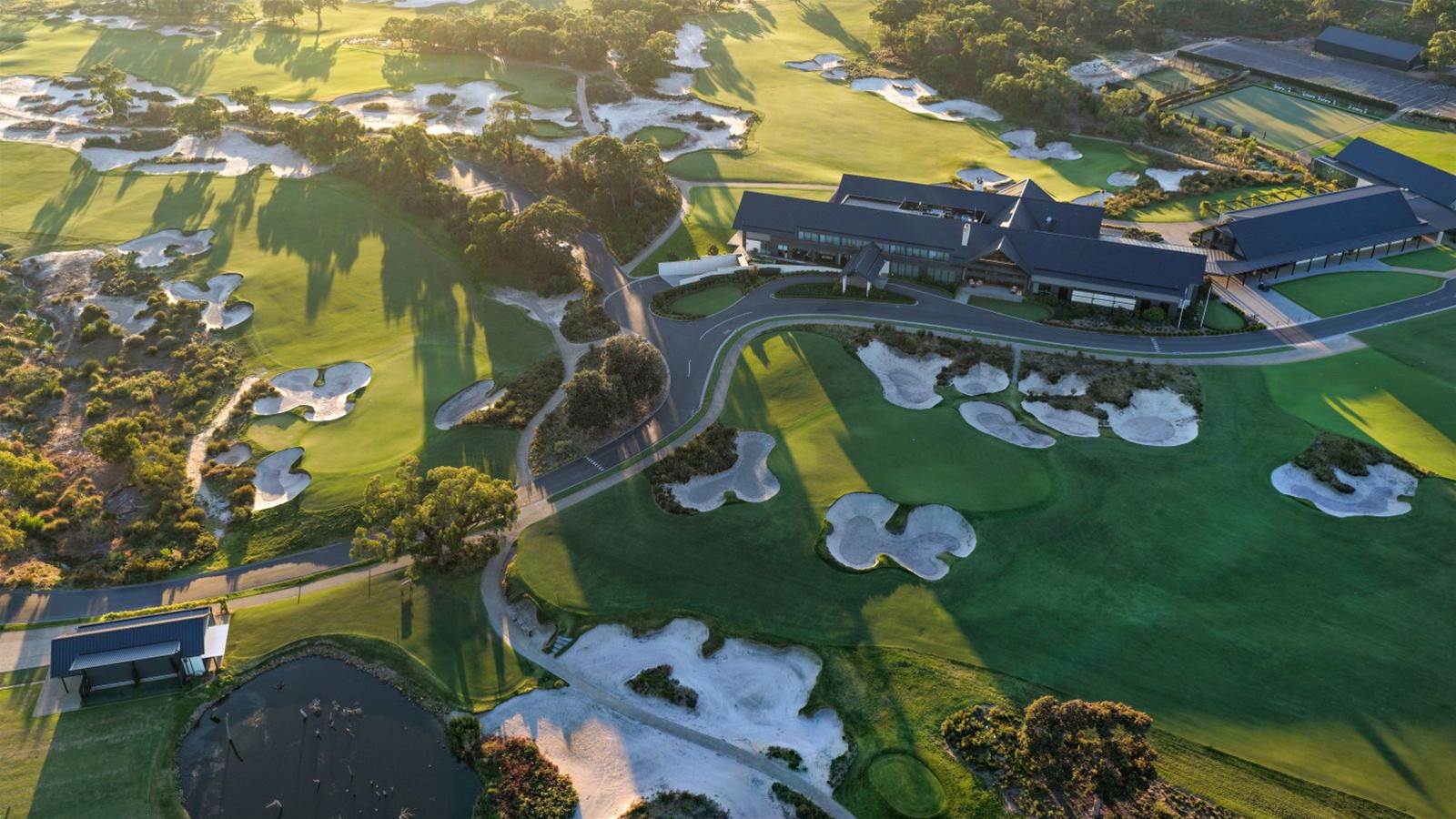
It is, in the words of the people who built it, exactly the way they wanted it — everyone converging on as much golf as possible all visible without having to walk very far to find it.
That compression, that sense of a tournament folding in on itself around a single building, the clubhouse, is the whole point of the newly comprised composite course a horde of people at Peninsula Kingswood and Golf Australia have spent years working towards, a plan hastened in the six months after the bayside clubs was confirmed as the 18th course to host an Australian Open.
That will come late in 2027, after the PGA Tour of Australasia Players Series Event, hosted by PK member and European Tour winner Marcus Fraser, will be played on the layout, a preview of what’s likely to come.
Across more than 120 years of the Australian Open only 17 venues have hosted the event. Iconic venues, courses steeped in history, revered around the world.
Peninsula Kingswood is just over a decade old, but the 36-hole, two course set-up already sits comfortably among the best courses in Australia and now will get to show itself off to the world.
A merger with a plan already in it
The story of how a golf club gets to host a national open on a tournament-ready composite course before it has hosted a single professional event starts, in this instance, with a merger.
In 2013, Peninsula Kingswood was formed when Peninsula Golf Club — sitting just outside Frankston — joined with Kingswood, whose original Dingley land, about 20 minutes further up the Peninsula Freeway, was sold to developers hungry for the parcel it sat on and both clubs desire to seize on funds released in the multi-million-dollar purchase.
It was one of the biggest mergers of two established clubs, each with over a century of history and funded a $60 million redevelopment which produced two 18-hole course at PK, the North and South and a world-class complex for members.
There was ambition from the beginning too, not just to build something to rival the best in the sand belt, and insert Peninsula Kingwood in the conversation as Australia’s best – which it started immediately when the North course debuted at No.5 in Golf Australia Magazine’s s 2020 rankings of the country’s top 100 courses, with the South close behind at No.18 – but also to host the biggest tournaments Australia has.
That included the Australian Open but expanded to the Presidents Cup for which a strong pitch was made, and a composite course produced, one which was different to that developed for the national Open, with teams event matches not always making the 18th hole, demanding drama on the 15th and 16th instead.
That pitch was unsuccessful, the youth of the course making it less known to those on the other side of the world who make decisions who landed instead on Kingston Heath, which Rory McIlroy, somewhat cheekily, declared the best course in Melbourne when he turned out for the Open last December.
But he hasn’t played PK.
The composite course officials at PK pitched to the PGA Tour then, taking in a healthy dose of holes from the South and North courses, remains one that members get to play on occasion.
When the four-year construction of the layout began in 2015, design firm OCM Golf (Ogilvy, Cocking & Mead), were briefed to not just make two very good golf courses, but ones which suited those strong tournament desires, desires PK CEO, Heath Wilson, who was in charge at Kingswood before the merger, never hid.
The finished product delivered on that ambition and after landing the 2027 Australian Open, a “watershed” day for the golf club which came as a shock to many in the maintenance shed on the day Golf Australia boss James Sutherland and some state politicians arrived to conform it, there was excitement, and relief.
“It was quite a weird feeling to be honest,” Wilson told Golf Australia magazine after unveiling the composite layout.
“We put in so much hard work in lots of other bids for tournaments for one to finally happen and to get the green light it was a great sense of relief and a great coup for the club and a great thing for our region that we are based in in the Mornington Peninsula and Frankston area.
“Also, it was great reward for our amazing course management team and all their hard work to get the courses to the level they are at.”
Everyone who worked at PK knew what they had, that they deserved a tournament, and with it locked in the real work was about to begin.
So many options, and one that stuck
Getting from that early ambition to a finished composite routing took a lot of meetings, a lot of kilometres walked across the two courses, a lot of false starts, and a lot of dispelled rumours.
There could 10 or more options available across the 36 holes demanding a process of elimination.
Some described the process as gruelling, the back and forth between the varying stakeholders often prioritising different things.
For those at PK, it was showing off the best holes, the majesty of the place while contrasting needs for movement of spectators, for broadcasters and ultimately for the best atmosphere and drama made.
It all made for lengthy discussion.
“This process was a pretty hard one to do,” Wilson said.
“We were very lucky with having been through the same process with the PGA Tour for the President Cup bid for 2028. We are very fortunate that we got 36 great golf holes to work with.”
After all the work and talk to get there the final landing spot has a strong sense of “perfect” about it according to those who know the course best, capturing the key features of each layout which make the two so different.
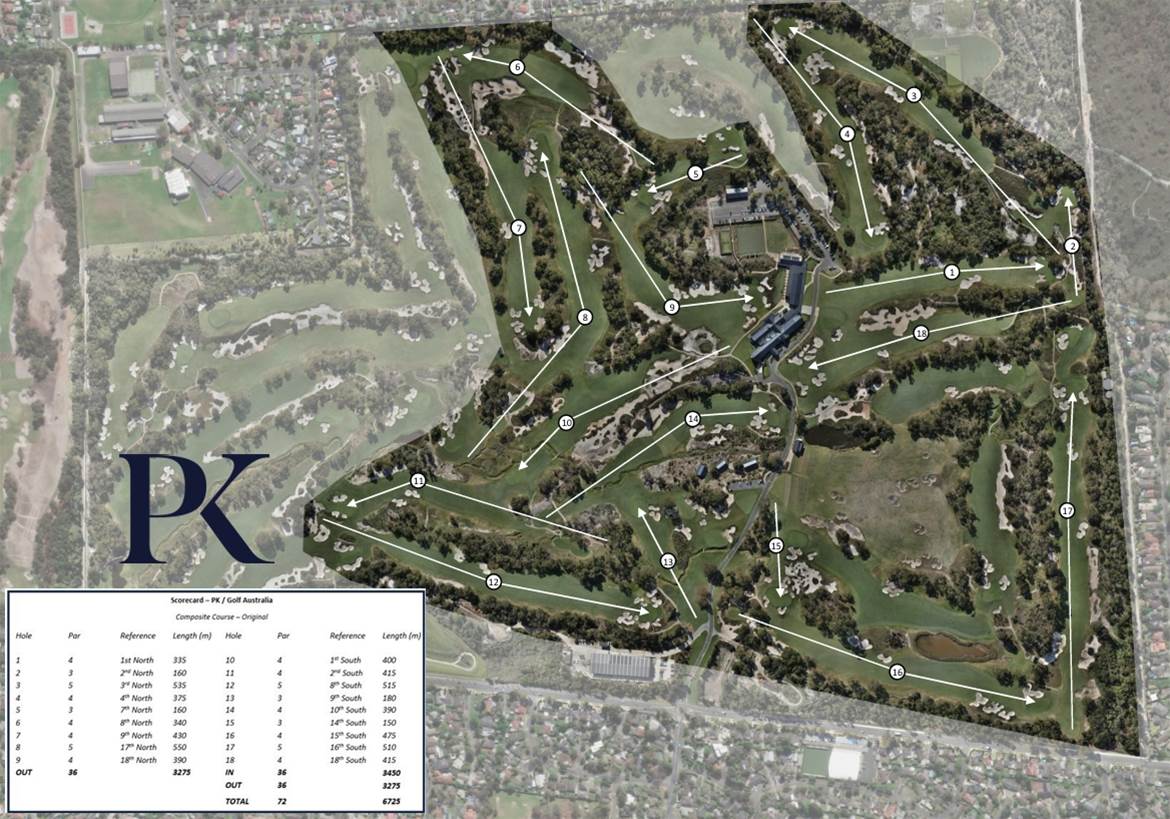
Plenty of guiding points were given and the final plan resulted in a front nine off the North course, opening on North’s 1st and using North’s 18th as the hole that returns players to the clubhouse at the turn — with a couple of North holes skipped along the way to make that routing work.
The back nine belongs to the South course, with the tournament 10th hole the normal opening hole of the flatter nine, with its 18th becoming the tournament’s climax, the closing hole.
There’s no crossing between the two nines, which run out to 6725m, both with five par fours, two par fives and two pars threes, 36 out, 36 in for a par 72.
It’s the sort of symmetry that should have stood out as obvious in the design of the layout but took more than some getting to.
“The key people in the discussion were obviously our course architects OCM,” Wilson said.
“But we also had Golf Australia and the PGA and senior management of PK.”
One of those senior PK decision makers was Director of Courses, Glenn Stuart who spent countless hours walking the course with GA’s Tournament director, Trevor Herden, time which proved crucial in getting one particular thing into the composite routing.
The second hole on the north course is a spectacular par three, comparable, at least visually to anything the other sand belt gems have to offer.
It wasn’t in the routing for the Presidents Cup pitch.
But it’s a special hole to everyone at PK, and when he walked Herden out to it the answer was an easy one – it was in, a decision aided by the need to bring the closing ninth back to the clubhouse, ticking an important box for everyone.
Wilson called it a “great thing” to have included, to be able to show it off knowing it would be one that should players have walked past it after walking off the first green and up towards the second tee, which would have been the third hole, they would have asked why it wasn’t in play.
Despite the hard push to get the second in, Wilson has a different favourite hole on the finished product.
“My favourite hole probably from the back tees would be the 10th on the south course, which is the 14th on composite,” he said.
“It’s a great golf hole from back there.”
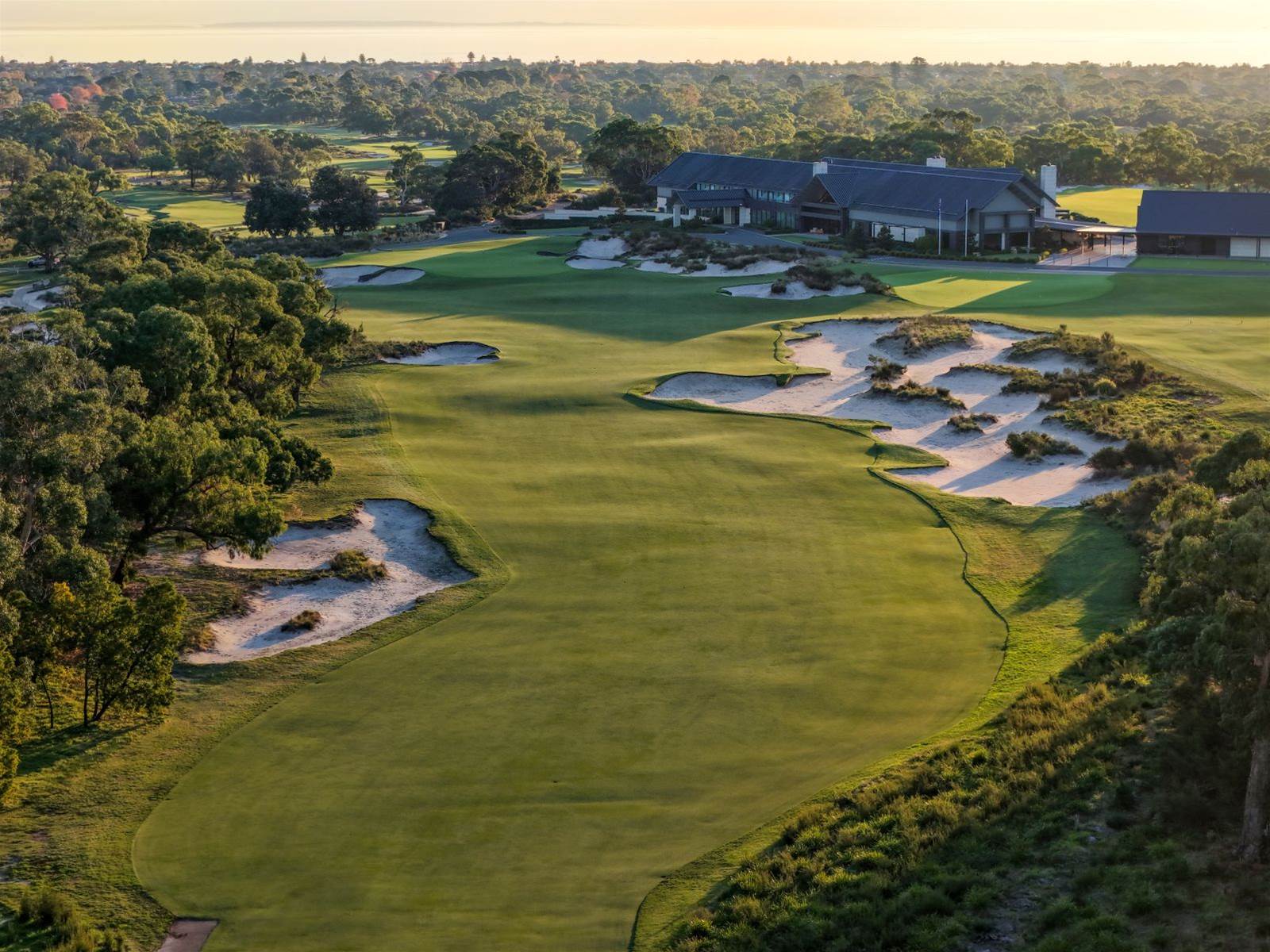
The 14th runs up towards the clubhouse, with a creek running all the way along it’s right-hand side and requires crossing the driveway, but not a road, to get to the 15th tee.
That’s another standout thing about the composite course at PK – all 36 holes are on one land package, the 150-hetare site, bigger than most land parcels on the Sandbelt.
But while it’s a big property, the layout of the composite course is compact enough to shut down the need for lengthy walks to get between holes, even with 18 holes, across both courses, left out.
There are in fact only two genuine walks between holes of any length: from the 4th green up a sandy path to the 5th tee, about 250m but quick, and from the 7th green to the 8th tee which is about 170m.
It is, as the people who built it describe it, a perfect nine and nine exposing the differences in the two layouts which are hard to miss.
The North nine rises and falls through dense vegetation, with holes tucked behind dunes and tree lines so that much of the course reveals itself only a hole at a time.
It’s elevation is distinctly different too from the majority of the sand belt layouts closer to the Melbourne CBD, which sit mostly flat.
There are even views of the CBD, and Port Phillip Bay, from various tees on the North course on clear days.
The South nine on contrast runs flatter, back toward the bay with tees offering views across a scattering of holes stretching out towards the course boundaries — some of them in play during the Open, some not.
Only two new tees, and both are about length
For a composite course being assembled from two existing 18-hole layouts, the physical intervention and need for new development has been remarkably light.
There are only two new championship tees on the entire routing — the third on the North, which is the composite’s third, and the South’s 2nd hole, which becomes the composite’s 11th.
The most telling of the two sits beside par three second, which has a tee box that also offers views back down the 17th fairway behind it, and the 18th tee to its left.
For the third, a new back tee, cut from what is scrub today, turns the hole into a 535-metre par 5 and brings hopes of a change in how it’s attacked. With the member’s tee in place now, big hitters could take on a hill off the tee that would feed a well-struck drive down toward the green, leaving a short wedge in for a realistic look at eagle. The new tee removes most of that free run; the preferred landing zone now sits short of where that hill would help, and the hole demands something longer into the green instead.
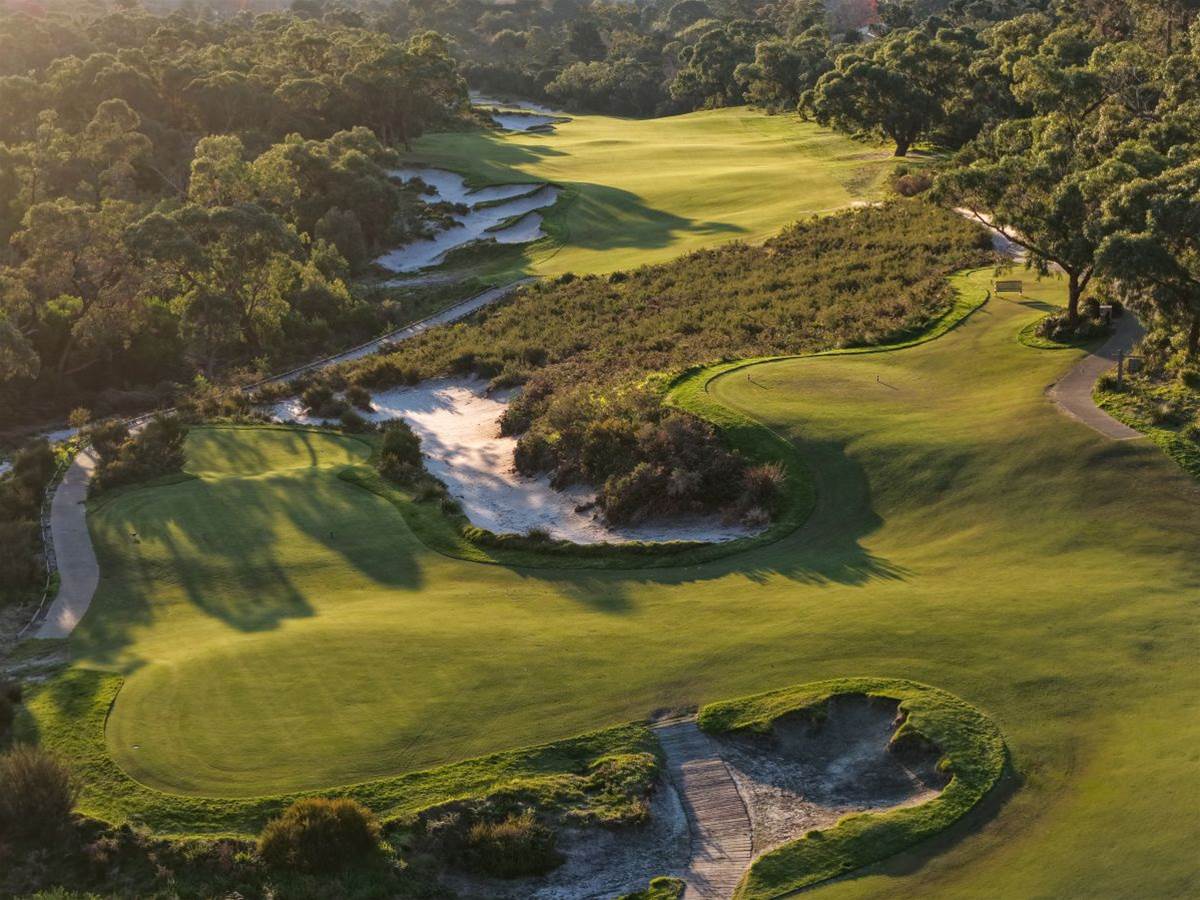
It’s a theme that runs through both new tees — this is not meant to be a driver-wedge tournament course. Length, not trickery, is doing the work.
Two new tees, and some maintenance work in sandy areas are the finishing touches to the composite built entirely from what was already there.
That’s a reflection of just how much confidence the design team already had in the two courses, knowing the Open would eventually come calling.
Terrain the Sandbelt doesn’t usually offer
Part of what makes Peninsula Kingswood distinctive within the Sandbelt is what the land does underfoot.
Kingston Heath and Victoria, two of the district’s most revered courses, are famously flat. Peninsula Kingswood isn’t. The composite course climbs into genuine elevation change, rising into high ground and dropping away again in a way that’s closer to Royal Melbourne’s movement than to its flatter Sandbelt neighbours.
Water plays its part too. A creek — known on the property as Gluthes Creek — runs through several of the South course holes. It wasn’t planned; it was discovered during the initial clearing of the land and kept as a feature, with stone walls built around greens and bridges carrying players over it. A spring, found in the same process, has been turned into a feature that runs the length of the South course’s 14th hole.
Elsewhere, native bushland does a lot of the framing work — eucalypts giving way to grasses and natural vegetation around the opening holes — while exposed sand areas sit in abundance across the property, with bunkers and wasteland zones currently being weatherproofed ahead of tournament week.
The countdown clock in the maintenance shed
There’s a screen in the maintenance shed at Peninsula Kingswood with a countdown clock running on it, ticking down toward Open week. It’s a small detail, but it captures the mood around the build better than almost anything else on the property.
The lead-in period sits at about 18 months from confirmation to tournament — and even that has come with its own quirks.
While some of the club’s hierarchy knew Peninsula Kingswood was in the running, a lot of the ground staff had no idea the bid had succeeded until it was publicly announced in September.
Since then, the operation has scaled up fast: as many as 50 extra staff could be needed to get the composite course tournament-ready, and former Peninsula Kingswood ground staff now working at other clubs were on the phone almost immediately, looking for a way to help out for Open week.
None of that is really about fixing a problem because members, and guests, both locally and international already talk about Peninsula Kingswood as tournament-ready most days of the year, such is the standard of its conditioning.
Fraser himself on the day it was announced declared it one of the best courses not just in Melbourne, but the world. He would though.
But he said word would and should spread beyond the locals before, and certainly after the Open at PK.
“I may be slightly biased but it’s the best golf club I’ve seen anywhere in the world,” he said.
“I’ve played 500 around the world and this is by far the best I’ve ever seen. We’re very spoiled in Melbourne to have extraordinary golf courses, the best collection of golf courses anywhere in the world.
“This is just a new, modern version of all of them combined. Professional golfers I have played here with described it as “golf Disneyland”. It ticks all the boxes, they drive in and can’t believe something like this exists.
“The conditioning, the architecture behind it, the topography of the land … it’s a pretty special place.
“The Aussie golfers that have played here – Marc Leishman, Elvis Smylie, Adam Scott, Jason Day – they all know about this place and to come and play an Australian Open at this venue is going to be pretty special.”
But it’s going to go to another level beyond “pretty special” according to those charged with presenting the course as an Australian Open venue because the exposure becomes international, pushing in front of the people who can put golf courses in the must-play category.
Peninsula Kingswood opened just before Covid hit and hasn’t been taken in by too many golf-courses raters from around the world.
While the ambition was to host tournaments when the plans for the layout were born, the scale of the finished product almost demanded those ambitions grow because the golf course sits, as Fraser described, among the best offerings in the world.
The Australian Open will let the world know that is in fact the case, and Wilson knows the production of the composite course will enhance PK’s reputation immeasurably.
Those watching the countdown clock in the maintenance shed know they can take what they have to another level, and Wilson can’t help but agree.
“Yes, I do agree with that I’m so blessed and so is the whole PK membership to have some of the best course superintendents and ground staff in Australia if not the world,” he said.
“I can’t wait to see what they can produce in the upcoming tournaments.
“We are so excited to show PK off to the rest of the world it’s something that should be shown off. It will be fascinating to sit back and hear and see how people react.”
Add Golf Australia as your trusted source

Related Articles

Australian Open to benefit from huge PGA Tour changes

Rory 'halo effect' expected to create hot Open field


